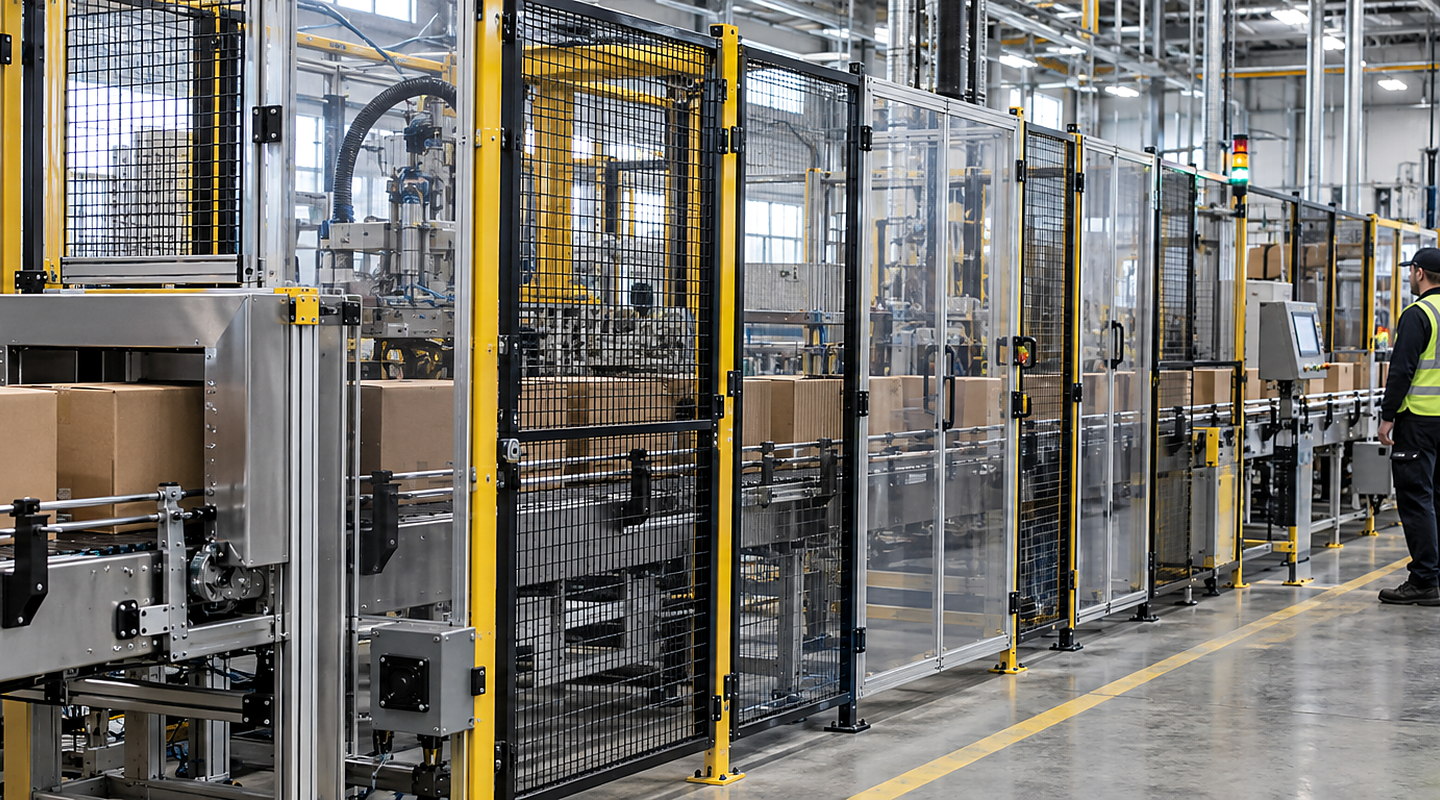
Conveyor Safety Systems Selection Guide
Compare conveyor safety proposals using the same access tasks, transfer openings, stopping boundaries, controls, visibility and installation-specific validation.
Compare conveyor safeguarding concepts against the same layout and task assessment. Distinguish product-transfer openings from access for people, and review what happens when one conveyor section stops while adjoining equipment continues. Have the required safeguards and safety functions assessed for the complete connected installation.
Use the survey specification checklist and validation evidence record. Assess each loading, transfer, cleaning and maintenance location instead of applying one arrangement to the whole route.
Compare options in the conditions where they must work — Conveyor Safety Systems
Plan conveyor safety systems around your machine hazards, operator tasks, access, stopping behaviour and validation evidence. Discuss a site-specific safeguarding concept with Oxford Machine Guarding. A useful shortlist should show how every option copes with hazards and foreseeable access for conveyor safeguarding & safety controls and space, visibility and operator ergonomics.
Discuss your application
Ask every supplier the same questions
| Decision | What to ask | What to check |
|---|---|---|
| Hazards and Foreseeable Access for Conveyor Safeguarding & Safety Controls | Which moving interfaces can be reached from the sides, below, platforms or neighbouring equipment? | Marked drives, rollers, return sections, transfers and access routes, including foreseeable cleaning and fault recovery. |
| Machine Motion and Stopping Behaviour | What happens when each section stops and connected machines or upstream material continue? | Existing stopping information and an assessed boundary covering adjoining movements, material or loads and the required response. |
| Operating, Cleaning and Maintenance Tasks | What purpose does each opening serve, and how often do people need to intervene? | Separate product loading/discharge, inspection, cleaning and maintenance tasks, with pack range and intervention frequency. |
| Existing Control-System Architecture | How do existing drives, safeguards and control interfaces support the proposed safety functions? | Available drawings, device and interface information, defined responsibilities and an assessment of the complete connected function. |
| Space, Visibility and Operator Ergonomics | Can the responsible operator see affected areas, and where may people remain after access or blockage recovery? | Visibility, occupied spaces, lighting and escape reviewed alongside the intended reset/restart response. |
| Risk-Reduction and Validation Evidence | What evidence and instructions will be handed over for the altered installation? | Altered sections/interfaces, agreed inspection and test records, validation responsibilities, outstanding actions and maintenance-access instructions. |
Include simpler approaches to conveyor safeguarding and safety controls in your shortlist
| Approach | Often suitable when | Watch for |
|---|---|---|
| Conveyor Safety Systems | You need a dedicated solution for a clearly defined duty, product or part range and line interface. | Current standards and required performance levels must be assessed for the complete machine and intended use. |
| Fixed Physical Guarding where Access Is Rare | Consider fixed guarding to prevent access to dangerous moving parts where it is practical for the assessed tasks. | Review loading, product-transfer openings, cleaning and maintenance access; a nominal barrier layout does not establish effective protection. |
| Interlocked or Presence-Sensing Protection where Frequent Intervention Is Foreseeable | Where fixed guarding is impractical for the assessed task, have suitable protective measures selected through competent review. | The choice depends on the actual access, stopping behaviour and complete safety function. Frequent intervention alone does not establish that a particular device is suitable. |
Pause before choosing when…
- Only perfect or hand-selected examples of safeguarding existing machinery for conveyor safeguarding and safety controls are available.
- No one has defined how risk-reduction and validation evidence will be evaluated.
- The normal range for hazards and foreseeable access for conveyor safeguarding & safety controls is described only as “usually fine” but has not been bounded.
- Your operator, cleaning, maintenance or recovery access has not been considered.
- Quoted performance depends on another machine or data source that is not included.